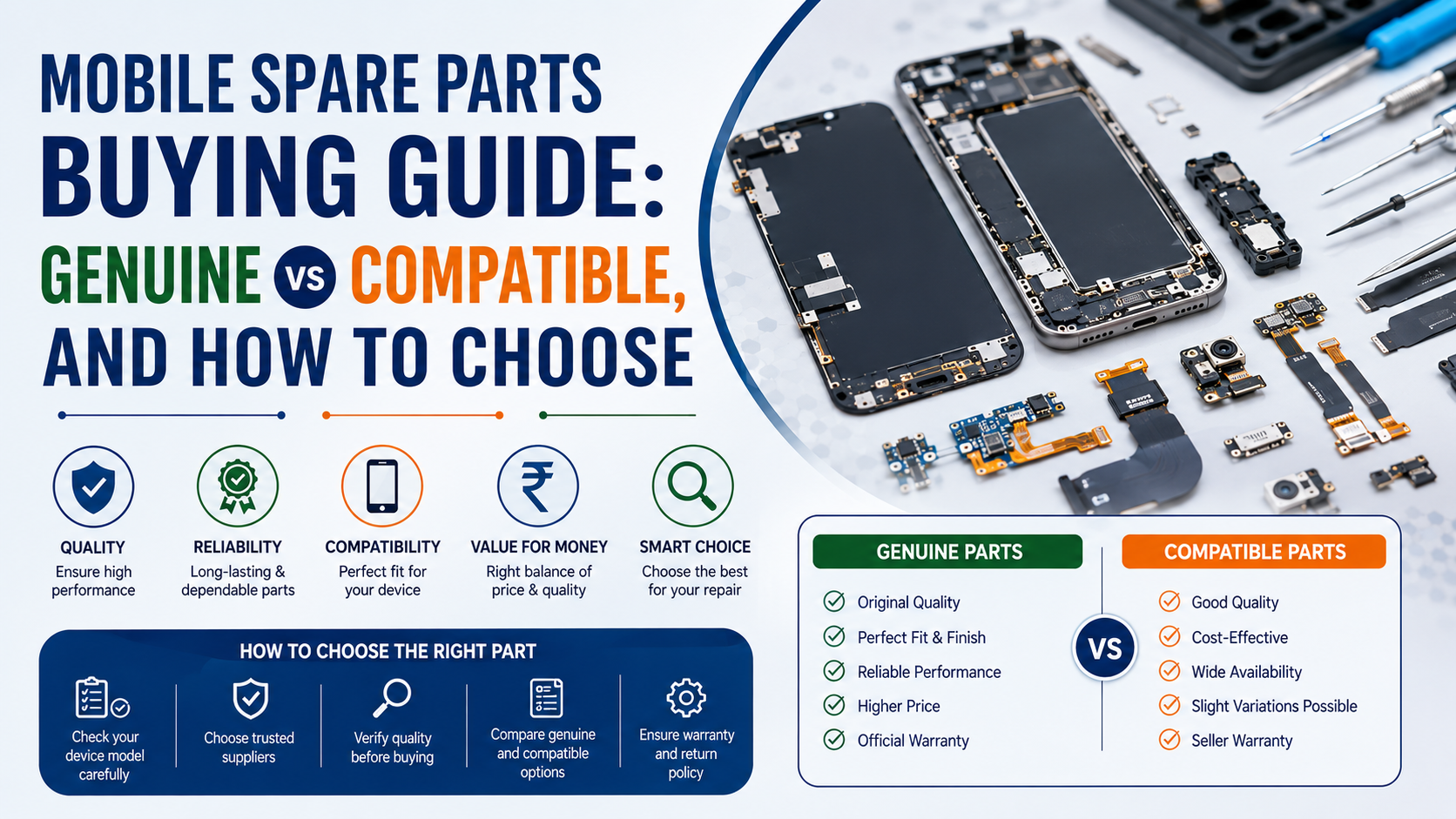
Mobile spare parts sourcing is where repair margins are made or lost. A batteries or display that fails in weeks doesn't just cost a replacement part — it costs labor, customer trust, and often a warranty claim the shop absorbs. Understanding what actually differentiates spare parts quality is essential for anyone buying regularly, whether for a single repair or shop-wide stock.
Genuine, OEM, and Compatible Parts — What's the Difference
Genuine parts are sourced directly from the original manufacturer's supply chain, typically salvaged from donor devices or authorized channels. These offer the closest match to original performance but usually cost more and can be harder to source consistently.
OEM-grade parts are manufactured to match original specifications, often by the same factories that supply components to device manufacturers, without the original branding. Quality can be very close to genuine but varies by supplier.
Compatible (aftermarket) parts are made to fit and function similarly but aren't manufactured to original specifications. Quality ranges widely — from genuinely reliable to unusable, depending on the manufacturer.
Knowing which tier you're buying, and for which repair, matters more than assuming "genuine" is always the right — or only — choice.
Common Spare Part Categories to Understand
Displays and screen assemblies — the highest-value, most frequently replaced part; quality differences here are the most visible to customers.
Batteries — safety-critical; low-quality batteries carry real risk of swelling or overheating, not just shorter life.
Charging ports and flex cables — small parts, but common failure points, especially in older or heavily-used devices.
Cameras and sensors — increasingly complex as phones add more sensors; compatibility varies significantly by exact model variant.
Back covers and housings — mostly cosmetic but affect water resistance ratings on newer devices if not properly fitted.
Buying Guide: What to Check Before Ordering Spare Parts
- Match the exact model and variant, including regional differences — the same phone name can have different internal parts by market.
- Ask which tier you're buying: genuine, OEM-grade, or compatible — and price accordingly rather than assuming.
- Prioritize genuine or OEM-grade for batteries and displays, where quality differences are most visible and safety-relevant.
- Check for supplier testing before shipping. Parts tested for function before dispatch reduce dead-on-arrival returns.
- Confirm return and warranty terms, since even quality parts occasionally arrive faulty.
Comparing Part Tiers
|
Tier |
Cost |
Reliability |
Best For |
|
Genuine |
Highest |
Highest |
Flagship device repairs, warranty-sensitive customers |
|
OEM-grade |
Mid-range |
High, supplier-dependent |
Most standard repairs where cost matters |
|
Compatible (aftermarket) |
Lowest |
Variable |
Budget repairs on older or lower-value devices |
Problem/Solution: Common Spare Parts Issues
Problem: A replacement display has color or touch inconsistencies. Often a sign of a lower-tier compatible part. Solution: for customer-facing repairs on newer or higher-value devices, invest in OEM-grade or genuine displays where the difference is visible.
Problem: A battery swells or degrades quickly after replacement. A serious safety issue, usually linked to low-quality cells. Solution: never compromise on battery quality tier — source from suppliers who can confirm cell quality and testing.
Problem: A part doesn't fit correctly despite matching the phone model. Frequently caused by regional or sub-variant differences within the same model name. Solution: confirm the exact model number and region variant with your supplier before ordering.
Problem: High return rate on bulk part orders. Often linked to suppliers who don't test parts before shipping. Solution: prioritize suppliers who confirm pre-shipment testing, even if it costs slightly more per unit.
Frequently Asked Questions
Are compatible mobile spare parts safe to use? Quality varies significantly by manufacturer and part type. Compatible parts can be reasonable for cosmetic or lower-risk components, but batteries and displays are worth prioritizing genuine or OEM-grade options.
How can I tell if a spare part is genuine? Reliable suppliers should be able to explain sourcing and, where relevant, provide testing confirmation. Unusually low pricing relative to market rate is often a signal of lower-tier stock.
What's the most commonly replaced mobile spare part? Displays and batteries are typically the highest-volume replacement parts across most repair shops, given how frequently they're damaged or degrade with use.
Should I buy spare parts in bulk? For frequently repaired models, buying core parts like batteries and common display sizes in bulk can reduce cost and turnaround time — but confirm supplier stock freshness, since some parts, like batteries, degrade in storage.
Source Reliable Mobile Spare Parts
Reliable repairs start with reliable parts. Akinfo Tools supplies genuine and OEM-grade mobile spare parts — displays, batteries, charging ports, and more — sourced and tested for shops and technicians across India.
Browse the Mobile Spare Parts range or contact us for bulk sourcing on your most-used components.