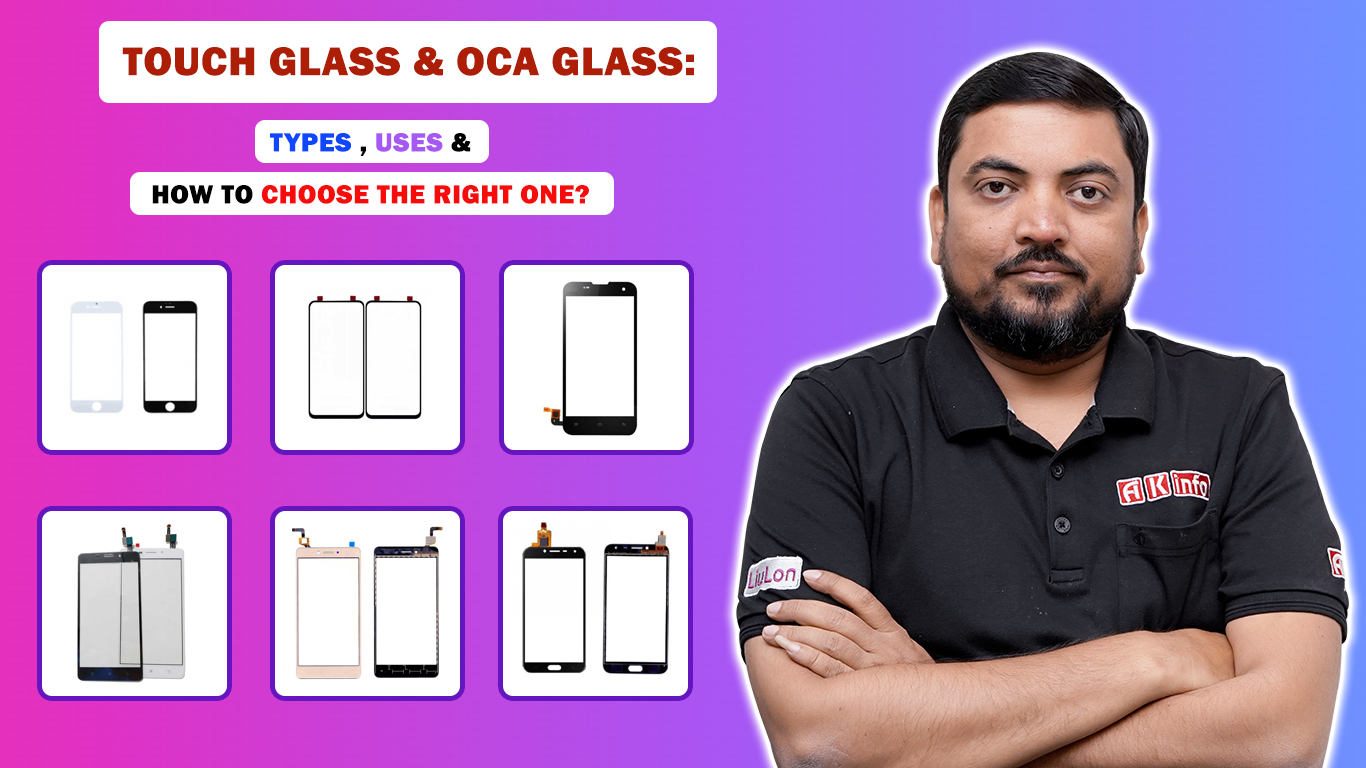
Touch glass and OCA (Optically Clear Adhesive) glass are two of the most repair-sensitive components a technician handles. Unlike a screwdriver or a spudger, mistakes here show up directly on the finished screen — as a bubble, a yellow tint, or a dead touch zone. Getting familiar with the types available and how to choose correctly is one of the highest-leverage skills in screen repair work.
What Touch Glass and OCA Glass Actually Do
Touch glass is the outer, user-facing layer of a display, responsible for both protection and touch sensitivity. OCA glass — more precisely, OCA sheets — is the clear adhesive layer that bonds the touch glass to the LCD or OLED panel beneath it, without introducing visible distortion or air gaps.
Both need to be matched precisely to the device model. A slightly wrong cut, thickness, or adhesive grade can cause a technically "successful" repair to look or perform poorly.
Common Types of Touch Glass and OCA Products
Standard OCA sheets — flat adhesive sheets cut to match specific device models, used in most flat-screen repairs.
Curved OCA sheets — designed for devices with curved-edge displays, requiring adhesive that conforms without stretching or creating uneven pressure points.
Polarizer-integrated sheets — combine the OCA layer with a polarizing film, simplifying certain repairs by reducing the number of separate layers to align.
Pre-cut touch glass panels — glass already sized and shaped to a specific device, reducing the risk of cutting or fitting errors compared to universal sheets.
Full-lamination OCA rolls — bulk rolls used by higher-volume shops with lamination machines, offering cost efficiency for shops doing large repair volumes.
Buying Guide: Choosing the Right Touch Glass & OCA Stock
- Match the exact model, not just the phone family. Even similar-looking models can have different cutouts, curvature, or thickness requirements.
- Check OCA freshness. OCA has a shelf life and degrades in poor storage conditions — ask about stock rotation and storage before ordering in bulk.
- Decide between sheets and rolls based on your volume. Individual sheets suit lower-volume or mixed-model shops; rolls suit high-volume, single-model repair lines.
- Prioritize clarity and thickness consistency. Inconsistent OCA thickness is a leading cause of visible bubbling after lamination.
- Buy from suppliers who specialize in repair-grade glass, since general electronics suppliers are less likely to carry model-accurate, freshness-verified stock.
Comparing OCA and Touch Glass Formats
|
Format |
Best For |
Trade-off |
|
Individual pre-cut sheets |
Mixed-model repair shops |
Higher per-unit cost than bulk rolls |
|
Bulk OCA rolls |
High-volume, single-model repair lines |
Requires a laminator and more setup time |
|
Polarizer-integrated sheets |
Faster repairs with fewer layers |
Less flexibility for mix-and-match repairs |
|
Curved OCA sheets |
Curved-edge display repairs |
Requires more careful, slower application |
Problem/Solution: Common Touch Glass & OCA Issues
Problem: Bubbles form after lamination. Usually caused by dust, debris, or uneven pressing. Solution: laminate in a clean environment and use a proper bubble-removal or press machine rather than manual pressing alone.
Problem: Touch glass doesn't sit flush with the frame. Often a sign the glass was cut for the wrong model variant. Solution: always confirm exact model numbers, not just the general device name, before ordering.
Problem: Discoloration appears within weeks of the repair. A common sign of expired or low-grade OCA. Solution: source OCA specifically for freshness assurance, and avoid unusually cheap, unbranded stock for customer-facing repairs.
Problem: Touch response is inconsistent after reassembly. Can result from air gaps or misaligned digitizer connectors. Solution: check connector seating carefully and use evenly-thick OCA to avoid pressure inconsistencies.
Frequently Asked Questions
What's the difference between touch glass and OCA glass? Touch glass is the visible, outer display layer; OCA glass is the clear adhesive that bonds it to the panel beneath. Both need to be matched to the exact device for a clean repair.
How long does OCA glass last in storage? Shelf life varies by product, but OCA is sensitive to heat and humidity — proper storage matters more than a fixed expiration date for maintaining bonding quality.
Is cheaper OCA glass worth using? For customer-facing repairs, generally not. Lower-grade OCA is more prone to yellowing, uneven bonding, and touch response issues, which often costs more in redone repairs than it saves upfront.
Do I need a laminator to work with OCA glass? For occasional repairs, manual application with careful technique is possible, but a laminator or press machine significantly reduces bubbling and improves consistency for regular repair work.
Source Reliable Touch Glass & OCA Stock
Getting touch glass and OCA right is as much about sourcing as technique. Akinfo Tools supplies model-matched touch glass, OCA sheets, and polarizers from established brands, with stock suited to both individual repairs and high-volume shop use.
Browse the Touch/Glass/OCA Glass range to find stock matched to your next repair.