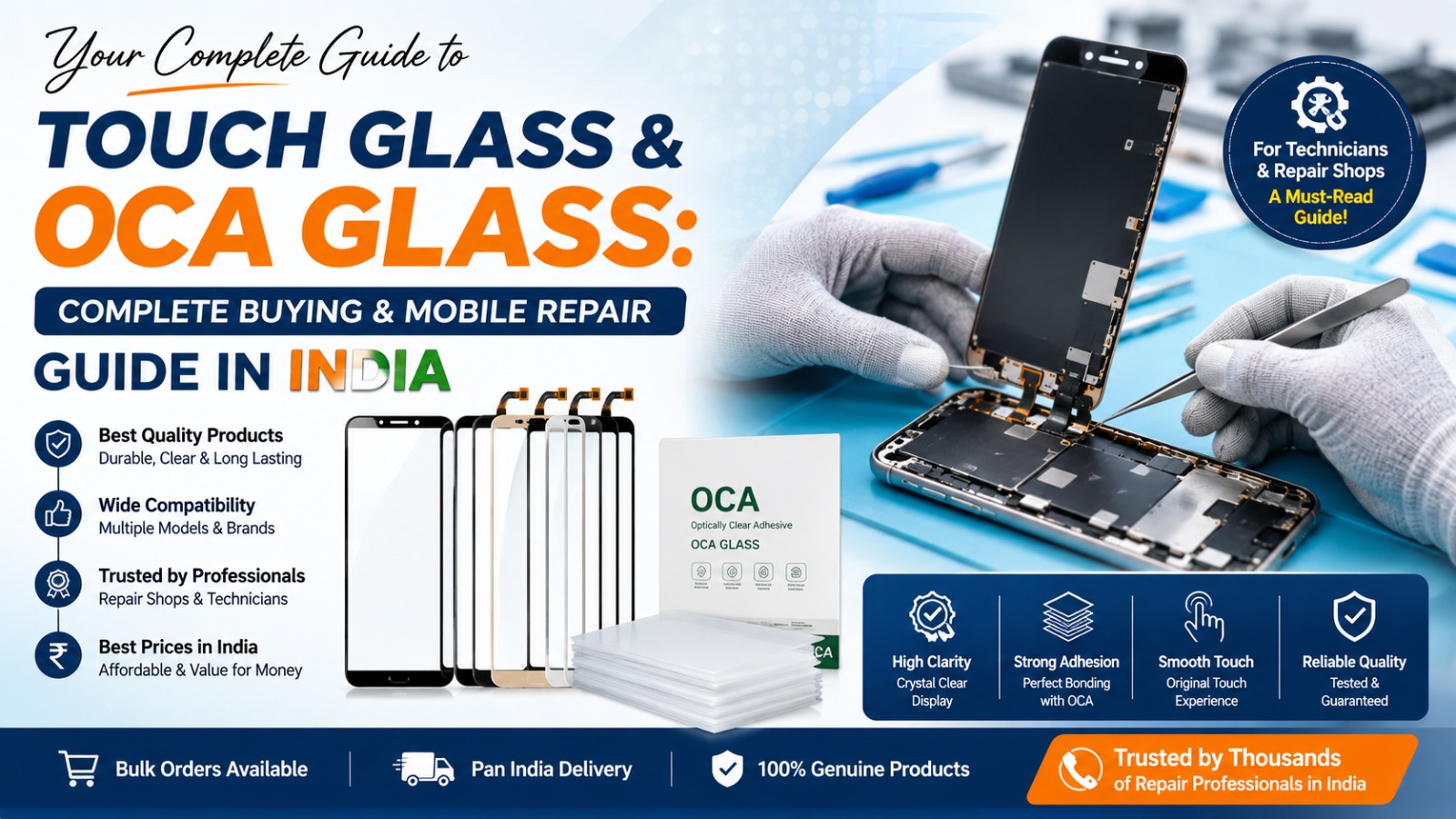
If you've spent any time repairing mobile screens, you already know Touch Glass and OCA are two of the parts you simply can't get wrong. Whether you're fixing an LCD or an OLED, the touch glass you pick and the quality of the OCA sheet you use will decide how the screen actually looks and feels once it's back together — clarity, touch response, the whole finish.
Use OCA that isn't up to standard and you're asking for trouble: bubbles showing up after lamination, a yellowish tint creeping in, patchy bonding, touch that doesn't respond the way it should. And it's not just the OCA — grab the wrong touch glass for a model and you'll fight fitting issues and touch problems too.
So let's get into it. This guide covers what Touch Glass and OCA Glass actually are, the different types you'll come across, how they differ from each other, the problems technicians run into most often, and how to actually pick the right product instead of guessing.
What Is Touch Glass?
Touch Glass is simply the outer glass layer on a phone's display — the part you're touching every time you use your phone. Beyond just letting your finger interact with the screen, it's also what takes the brunt of scratches and everyday knocks.
Here's the thing a lot of people don't realize: if a phone's outer glass cracks but the LCD or OLED panel underneath still works fine, and touch is still responding properly, you often don't need to replace the whole display. A technician can just swap the touch glass and laminate it back on with OCA — much cheaper, much faster.
But this only works if you get the details right. Exact model, glass size, thickness, where the edges sit, camera and sensor cutouts, the display design itself — miss any of that and the repair won't sit right.
What Is OCA Glass?
OCA stands for Optically Clear Adhesive. It's a thin, transparent adhesive film — think of it as the glue layer, except it's engineered to be completely clear — that bonds the touch glass to the LCD or OLED panel underneath.
When it's laminated correctly, OCA closes up the air gap between the glass and the display. That's what keeps the screen looking the way it originally did, with no dullness or distortion creeping in.
What actually separates good OCA from cheap OCA:
- High optical clarity
- Consistent thickness across the sheet
- Bonding that's strong and even, not patchy
- Minimal yellowing over time
- Good behavior during lamination
- Resistance to bubbling
Skimping on OCA quality is one of those shortcuts that always shows up later — usually right after the customer picks the phone up.
Touch Glass vs OCA Glass: What's the Difference?
| Feature | Touch Glass | OCA Sheet |
|---|---|---|
| Main purpose | Outer glass and touch layer | Bonds the glass to the LCD/OLED |
| Form | Glass panel | Transparent adhesive film |
| Where it sits | Outer surface of the display | Sandwiched between the glass and the display |
| When it's replaced | When the glass is broken | During the lamination step |
| Model matching | Needed | Needed |
| What matters most | Cutting, fit, clarity | Adhesion, clarity, thickness |
Put simply: Touch Glass is what the user sees and touches. OCA is the invisible layer doing the actual work of holding that glass to the panel underneath.
Common Types of Touch Glass & OCA Products
1. Standard OCA Sheets
These are your everyday, flat-display OCA sheets — the ones you'll reach for most often. They come sized for different models and specs.
Good for:
- Everyday flat-screen repairs
- LCD refurbishment
- OLED screen refurbishment
- Shops handling a mix of models
2. Curved OCA Sheets
Made specifically for phones with curved displays. These take more care to laminate since you're working around curved edges rather than a flat surface.
Good for:
- Curved-edge displays
- Premium/flagship phones
- Curved OLED refurbishment
If you're working with curved OCA, pay extra attention to alignment and how evenly you're applying pressure — that's where most mistakes happen.
3. Pre-Cut Touch Glass
This comes already cut to the exact size and shape needed for a specific model, so there's no manual trimming involved.
What that gets you:
- Better fit accuracy
- Faster turnaround
- Fewer cutting mistakes
- A cleaner, more consistent finish
4. Polarizer-Integrated OCA Sheets
Some OCA sheets come with a polarizer layer already built in, which cuts down on having to juggle separate layers during the repair.
Just make sure you check compatibility with the display type and your refurbishment process before using these — they're not a drop-in replacement for every job.
5. OCA Rolls
If you're running a high-volume shop, rolls make more sense than individual sheets. Buying in bulk this way usually works out cheaper per repair and keeps the workflow moving.
Good for:
- High-volume repair operations
- Professional refurbishment shops
- Places doing multiple screens a day
- Anyone running a lamination machine
Just know that rolls come with extra responsibility — proper cutting, careful storage, and a lamination setup that can actually handle them.
How to Choose the Right Touch Glass & OCA
Knowing the phone brand isn't enough. You need the exact model and display variant confirmed before you order anything.
1. Nail Down the Exact Model
Even within the same series, variants can differ in glass size, camera cutout position, sensor placement, or display structure. Before you order:
- Confirm the exact model number
- Check the display size
- Confirm flat vs. curved
- Check camera and sensor cutouts
- Verify glass thickness and shape
2. Get the OCA Size Right
The OCA sheet has to match the display panel size. Go too small, or use the wrong size, and you'll end up with uneven bonding after lamination.
Sheets matched to the exact model make the whole installation smoother and more predictable.
3. Actually Check the OCA Quality
Optical clarity and consistent thickness aren't optional extras — they're the whole point. Cheap out here and you'll eventually see:
- Yellowing
- Haze
- Bubbles
- Uneven bonding
- Touch that doesn't respond properly
4. Don't Ignore Storage and Freshness
Heat and humidity are OCA's enemies. Before buying in bulk, it's worth asking your supplier a few questions:
- How is it stored?
- Is stock being rotated properly?
- When was it manufactured?
- Is the packaging intact?
5. Sheets or Rolls?
Depends entirely on your volume.
Sheets work well if you're a mixed-model shop doing low-to-medium volume.
Rolls make more sense once you're doing high-volume refurbishment regularly.
Common Touch Glass & OCA Problems
Problem 1: Bubbles After Lamination
Probably the most common complaint technicians run into.
What usually causes it:
- Dust getting trapped
- Improper cleaning beforehand
- Uneven pressure during lamination
- Poor-quality OCA
- A lamination process that wasn't done right
Fix: Clean the LCD/OLED and glass thoroughly before you start, and use a proper laminator along with bubble-removal tools rather than trying to eyeball it.
Problem 2: Glass Won't Sit Flush in the Frame
If the touch glass isn't sitting flat against the frame, chances are it's the wrong model or variant.
Fix: Never order based on just the phone family or series name. Confirm the exact model number every time.
Problem 3: Yellow Tint Showing Up
A yellow or discolored tint after lamination almost always points back to low-quality or unsuitable adhesive.
Fix: Stick to repair-grade OCA that's been stored properly — this one's really about sourcing, not technique.
Problem 4: Touch Isn't Responding Evenly
If certain parts of the screen aren't picking up touch properly, look at the connector seating, whether the assembly was done right, air gaps, or uneven pressure during bonding.
Fix: Check the touch connector's seating, and make sure you're applying uniform pressure with the correct OCA thickness.
Tips for Professional OCA Lamination
Good OCA alone won't save a sloppy process. Both need to be right.
Worth building into your routine:
- Keep the work area dust-free
- Clean the LCD/OLED surface carefully
- Use OCA matched to the exact model
- Avoid touching the OCA more than necessary
- Take your time aligning glass and panel
- Use a proper laminator
- Follow through on bubble removal properly
- Test touch and display before final assembly
Stick to these and you'll cut down on rework and the awkward conversations that come with customer complaints.
Touch Glass & OCA Buying Guide for Repair Shops
Running a repair shop or refurbishment business? Chasing the lowest price on stock is a trap. Here's what actually matters more:
Model Accuracy — get the right model and variant, every time.
Optical Clarity — OCA needs to stay transparent and not interfere with the display.
Thickness Consistency — even thickness means better lamination and a cleaner finish.
Stock Freshness — prioritize stock that's been stored properly and isn't sitting around aging.
Supplier Reliability — buy from someone who actually specializes in mobile repair and refurbishment supplies, not a general seller.
Frequently Asked Questions
What's the actual difference between Touch Glass and OCA? Touch Glass is the outer glass layer of the display. OCA (Optically Clear Adhesive) is the transparent adhesive sheet that bonds that glass to the LCD or OLED panel underneath.
Can the same OCA work for both LCD and OLED? Not always — OCA comes in different specs depending on the display and the application, so match it to what you're actually working on.
Why do bubbles keep showing up after lamination? Usually dust, trapped air, uneven pressure, wrong lamination settings, or just poor-quality OCA.
How should I be storing OCA sheets? Follow the manufacturer's storage guidance, and keep it away from heat, humidity, and direct sunlight.
Does paying more for OCA guarantee better quality? Not necessarily. Price isn't a reliable signal on its own — look at optical clarity, thickness consistency, bonding performance, freshness, and who you're buying from.
Do I really need a laminator for OCA work? For a one-off repair, manual methods can get you by. But if you're doing this regularly, a proper laminator and bubble-removal equipment will save you a lot of headaches and give you a more consistent finish.
How do I make sure I'm buying the right Touch Glass? Confirm the exact model number, display size, glass shape, cutouts, thickness, and whether it's flat or curved — every single time.
Buy Touch Glass & OCA Glass for Mobile Screen Repair
Getting the right Touch Glass, OCA Sheets, polarizers, and other screen repair supplies makes a real difference in the quality of your repairs — it's not just a minor detail.
Akinfo Tools Pvt. Ltd. stocks model-specific Touch Glass, OCA Glass, OCA Sheets, and other screen refurbishment products built for repair professionals.
Whether you need a single pre-cut OCA sheet for one model or bulk stock for a high-volume operation, take the time to verify the specs before you buy — it saves you more trouble than it costs.