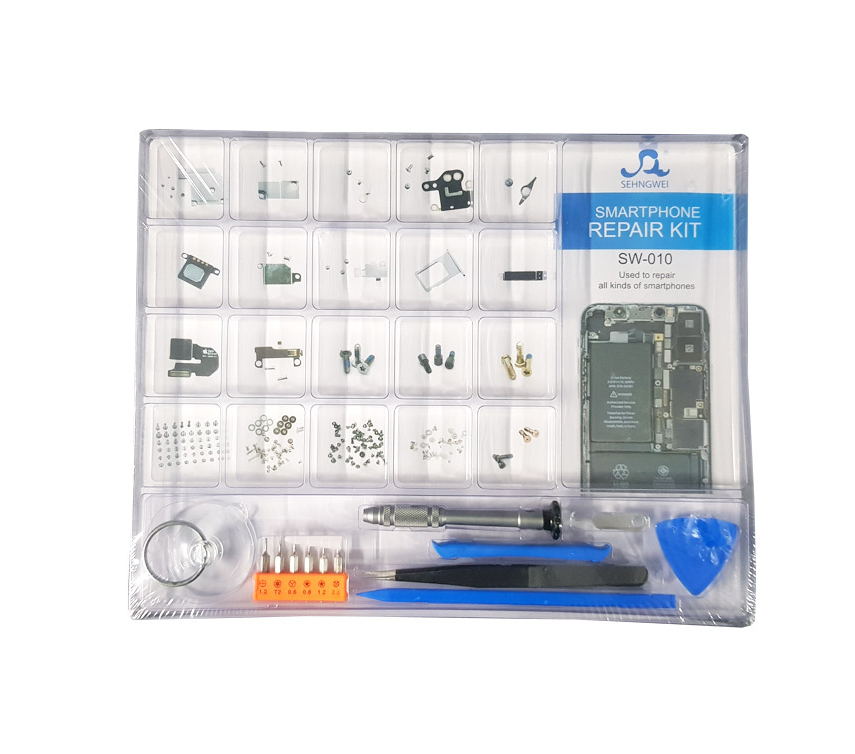
Every technician's bench looks different, but the logic behind a good one is always the same. You buy the tool that unlocks the next class of repair you can charge for — then you buy the next one. Buy in the wrong order and you end up with an expensive bench that still can't do board-level work.
This is a working list of the mobile repairing tools that matter, what each one actually does on the bench, and which ones to buy first. It's written for people who repair phones for a living or are about to start — not as a shopping list, but as an explanation of why each tool exists.
What are mobile repairing tools?
Mobile repairing tools are the hand tools, powered instruments and consumables used to open, diagnose, repair and reassemble mobile phones. They differ from general electronics tools in three ways that matter every single day.
Scale. A phone motherboard packs components measured in fractions of a millimetre. A 0201 resistor is roughly the size of a grain of salt. Tools built for general electronics are simply too coarse — the tip is too broad, the tweezers too thick, the iron too hot in the wrong place.
Density. Everything is stacked. Shields sit over ICs, ICs sit over vias, and a hot air gun aimed carelessly at one component reflows six others underneath. Precision here means controlling heat and force in a very small area.
Fragility of the parts you're trying to save. Most phone repair is about not damaging the 95% of the board that is fine while you work on the 5% that isn't. That's why so much of a repair bench is about seeing, holding and measuring rather than cutting and soldering.
The four families of tools on a repair bench
Almost every tool on this page falls into one of four groups. Thinking in families rather than individual products makes it much easier to spot the hole in your own setup.
- Opening and disassembly — getting into the device without breaking glass, frames or flex cables.
- Diagnosis and measurement — finding out what is actually wrong before you touch an iron.
- Soldering, desoldering and rework — the repair itself, at component and board level.
- Cleaning, curing and finishing — recovering corroded boards and putting the device back together properly.
A common mistake is to over-invest in family three and under-invest in family two. Technicians who can solder beautifully but can't diagnose end up replacing parts by guesswork — which is slow and expensive.
The mobile repairing tools list, and what each one does
Here's the full working list. Each entry explains the job the tool does, not just its name.
Screwdriver sets and electric screwdrivers
Phone screws are tiny and soft, and the heads strip easily. A repair-grade mobile screwdriver set gives you the specific profiles phone makers use — Phillips PH000 and PH00, Pentalobe P2 and P5 for Apple, Torx T2 to T6, and the tri-point Y000 found on batteries and shields.
Two things separate a good set from a cheap one: bit hardness, and how tightly the bit sits in the driver. A soft bit rounds off inside the screw head on the first stubborn screw and now you have a much bigger problem. An electric screwdriver is worth adding once volume picks up — on a device with 30+ screws it saves real minutes per unit, and consistent torque means fewer stripped threads.
Opening tools, blades and picks
Mobile opening tools — spudgers, nylon picks, guitar picks, suction cups — separate glued assemblies without scratching or shorting anything. Nylon and fibreglass are the point: a metal pry bar against a live board is how you turn a screen job into a board job.
Thin steel mobile blades handle adhesive and shield removal where a plastic pick won't get purchase. Keep them sharp and keep them separate from your board tools — a blade dulled on adhesive will slip.
Tweezers
You will use repairing tweezers more than any other tool on the bench. Buy several: fine straight tips for placing components, curved tips for lifting flex connectors, and a heavier pair for shields and general handling.
Look for non-magnetic, anti-static stainless steel with tips that meet cleanly along their whole length. Hold a pair up to the light — any gap at the tip means small components will ping out and disappear. That's the entire test.
PCB stands and fixtures
A PCB stand holds the board still so both your hands are free and heat can reach from below. Trying to rework a board you're holding down with a finger is how components move mid-reflow.
Universal spring-clamp fixtures cover most work. Once you're doing regular BGA work, a magnetic reballing platform like the 2UUL BH17 dual-sided reball base pays for itself in alignment accuracy alone.
Repairing pads and ESD mats
A silicone repairing pad does three jobs at once: it resists the heat that rolls off a hot air gun, it stops screws rolling off the bench, and — if it's a proper grounded ESD mat — it dissipates static that would otherwise walk into a CPU through your fingertips.
Static damage is the failure mode nobody sees happen. A board that works on the bench and dies a week later at the customer's house was often killed by a discharge during the repair.
Soldering irons and stations
A soldering station is the first serious purchase most technicians make. What you're buying is not heat — it's temperature stability. A cheap iron reads 350°C and delivers 280°C the moment the tip touches a ground plane, so you sit there heating a pad far longer than you should and lift it.
Cartridge-tip systems (the T12 and 210 standards) put the heating element inside the tip itself, so recovery is near-instant. The Mechanic T12 Pro Max is the volume seller here for a reason — it sits at the point where a cartridge station stops being an upgrade and starts being the baseline.
Get a range of tips: a fine conical for micro-soldering, a knife or chisel for drag-soldering connectors, and a small hoof for pulling excess solder.
SMD hot air rework stations
Where an iron heats one joint, a hot air gun heats a whole component's worth of joints at once. That's what you need for shields, connectors, ICs and anything BGA. An SMD rework station is the dividing line between screen-and-battery work and genuine board-level repair.
Three things matter: how tightly it holds a set temperature, how finely you can control airflow, and the nozzle set. Airflow is the one beginners underrate — too much air and you blow 0201 components off the board while trying to lift a shield. Stations like the Quick 857DW+ and the larger Quick 861DW are the common steps up.

Solder paste, flux and PPD
Flux is not optional and it is not glue. It chemically strips oxide off the pad and the joint so solder can actually wet the surface. Most bad joints that technicians blame on their iron are flux problems.
Keep two kinds on the bench. Solder paste for placing and reflowing components, and a good no-clean or rosin flux for everything else. PPD and BGA flux are the higher-temperature formulations that survive a full reflow cycle without burning off — which is exactly what you need when reballing.
Watch the expiry date on paste and store it cold. Old paste with separated flux produces cold joints that pass a visual check and fail in the customer's pocket.
Desoldering wire and wick
Desoldering wire — braided copper wick — pulls old solder off pads by capillary action. It's how you clean a pad set flat before placing a new IC, and how you rescue a bridged connector.
Buy fine widths for phone work. A 3 mm braid on a 1 mm pad will lift the pad. And use flux with it, always — dry wick just sits there absorbing heat.
DC power supplies and boot cables
This is the diagnostic tool that separates guessing from knowing. A DC power supply feeds the board directly and shows you exactly how much current it draws. That number tells you the fault before you open anything:
- Zero draw — the board isn't getting power. Look at the charging path.
- A dead short — a shorted line, usually a capacitor. Find it before you power anything else.
- A small steady draw that never rises — the board is powered but not booting. Suspect the CPU rail or a bootloader issue.
- A normal boot curve — the board is alive and the fault is elsewhere.
Units like the Mechanic DP3010 and the Sugon 3005PM cover phone work comfortably. Pair the supply with boot cables matched to the models you see most — the cable is what lets you power and boot a board with no battery attached, so pinout compatibility is the thing to check before buying.
Multimeters and measuring instruments
A digital multimeter is your continuity, diode-mode and voltage check in one. Diode mode is the one you'll live in: it reads the voltage drop across a component and tells you whether a line is shorted, open or normal. Learning the normal diode values for the boards you work on is the single highest-return skill in board repair.
The Sunshine DT-17N is a solid working meter. For deeper fault-finding, waveform meters like the JTX A9 let you see signals a plain multimeter can't — useful on charging and audio faults where the line is present but wrong.
Stereo and digital microscopes
You cannot repair what you cannot see. A microscope is not a luxury for board-level work — it's the entry ticket.
A trinocular stereo microscope gives you true depth perception through the eyepieces plus a third port for a camera, which matters both for showing customers the fault and for training. Working range of roughly 7× to 45× covers almost all phone work: low magnification to navigate the board, high to inspect a joint. The SOPTOP SZM-7060Pro is the common workhorse; the SOPTOP 71 Pro Max sits a tier above it.
Two details people forget: check the working distance — you need room to get an iron under the lens — and add a 0.5× Barlow lens, which increases that distance and widens the field of view at the same time.

LCD screen separator machines
A screen separator machine heats a display assembly evenly so you can cut the glass away from the OLED or LCD underneath with wire. It's the core tool of glass-only refurbishing, where you save the panel and replace just the broken outer glass — a far better margin than swapping the whole assembly.
Even heat is the whole game. Hot spots crack panels, and a cracked panel turns a profitable job into a loss.
UV curing lights
UV curing lights set UV-cure adhesives and solder mask. Two uses: bonding screens and glass in refurbishing, and repairing damaged solder mask on a board so adjacent traces stay insulated after a repair. Cure time depends on lamp power — under-curing leaves a tacky surface that traps contamination.
Cleaning brushes, cloths and ultrasonic cleaning
Liquid-damaged boards are corrosion problems, not water problems. Anti-static cleaning brushes with isopropyl alcohol lift residue and flux from around components; lint-free cleaning cloths finish screens and housings without scratching.
For serious corrosion an ultrasonic cleaner is the right tool — we covered the full method in our guide to ultrasonic cleaning for liquid-damaged boards.
Activation boards
Activation boards wake and test batteries and boards outside the phone. Practically, they let you charge a deeply discharged battery that a phone refuses to recognise, and confirm a battery is healthy before you blame it for a fault.
Nippers and cutters
Flush-cutting nipper cutters trim component legs, wire and cable ties close to the surface. The word that matters is flush — a cutter that leaves a stub on a jumper wire leaves something for a shield to short against later.
Glue remover motors
A glue remover motor spins a rubber wheel that strips cured OCA adhesive off a panel without solvents and without the hours of manual scraping the job otherwise takes. If you refurbish screens in any volume, this is one of the fastest payback tools on the bench.
Reballing platforms and stencils
Reballing is re-forming the ball grid array under an IC so it can be re-seated. It needs a stencil that matches the chip, solder paste, a heat source and a platform that holds everything in alignment. Our reballing stencils range covers the common CPU, power and baseband ICs — and if you're weighing up a dedicated station, start with our BGA rework station buying guide.
Beginner vs professional: two bench builds
The most useful question isn't "what tools exist" — it's "what do I buy first". Here are two honest configurations.
The starter bench
This gets you doing screens, batteries, charging ports and basic component work — the repairs that make up most walk-in volume.
- Precision screwdriver set with Phillips, Pentalobe, Torx and tri-point bits
- Opening tool kit — spudgers, picks, suction cup
- Two or three pairs of tweezers, straight and curved
- Silicone ESD repairing pad
- Cartridge-tip soldering station with a small tip set
- Flux and thin solder wire
- Desoldering wick
- Digital multimeter
- Isopropyl alcohol and anti-static brushes
Buy in that order. The temptation is to buy a microscope first because board repair looks impressive. Don't — a microscope with no diagnostic skill behind it just gives you a very clear view of a fault you can't identify.
The professional bench
These are the upgrades that unlock board-level work and the jobs nobody else in your area will take.
- Trinocular stereo microscope with a 0.5× Barlow lens and ring light
- SMD hot air rework station with a full nozzle set
- DC power supply plus boot cables for your common models
- PCB fixture or reballing platform
- Waveform meter for signal-level faults
- Screen separator and glue remover motor if you refurbish displays
- Ultrasonic cleaner for liquid damage recovery
- Thermal camera — a tool like the Mechanic iScout finds a shorted component in seconds by showing you which part is getting hot

How to choose mobile repairing tools
Quality and originality
Every popular tool in this trade has clones. Some are honest budget alternatives; many are counterfeits carrying a real brand's name. The practical difference shows up in the parts you can't see — the heating element, the temperature sensor, the internal wiring. A clone station that overshoots its set temperature by 40°C will lift pads, and you'll blame yourself.
Buy from a source that states clearly whether an item is original, and that will still be there when a heating element fails in month four.
Compatibility
Check these before you buy, not after:
- Soldering tip standard — T12, 210 and 245 are different families. Tips are not interchangeable, and tip availability determines the real cost of ownership.
- Boot cable pinouts — must match the models you actually service.
- Microscope lens mount and working distance — a Barlow lens has to fit your specific head.
- Power supply range — for phone work you want fine current resolution at low currents far more than a high maximum.
- Hot air nozzle fitment — nozzle sets are model-specific.
Precision and repeatability
Precision is not the number printed on the display — it's whether the tool does the same thing twice. A station that holds 350°C under load is worth far more than one that claims 480°C maximum. When you're comparing two products, look for temperature stability and airflow control before you look at peak specifications.
Durability and serviceability
Bench tools are consumables with long lives. Ask what wears out and whether you can replace it: soldering tips, heating elements, hot air handles, microscope bulbs, brush heads. A tool with an available spare-parts chain outlasts a sealed unit that has to be thrown away when one part fails.
The brand landscape
A quick orientation to the names you'll see:
- Mechanic — broad range across soldering, power supplies, fluxes and inspection. Strong all-rounder.
- Sunshine — measurement instruments, screwdrivers, separators. Good value at the working end.
- Qianli and 2UUL — precision hand tools and fixtures, aimed at micro-soldering.
- Relife — wide accessory and fixture range.
- Sugon and Quick — soldering and rework stations, with Quick a long-standing reference in hot air.
- SOPTOP — microscopes.
- MaAnt — specialist micro-soldering and inspection tools.
What mobile repairing tools cost in India
Prices for reference, taken from our catalogue at the time of writing. Check the mobile repairing tools category for current pricing.
| Tool | Typical range | Example |
|---|---|---|
| Screwdriver sets | ₹200 – ₹2,000 | Multi-bit repair sets |
| Tweezers | ₹100 – ₹1,500 | Per pair, anti-static |
| Soldering station | ₹2,000 – ₹10,000 | Mechanic T12 Pro Max ≈ ₹1,998 |
| Digital multimeter | ₹500 – ₹3,000 | Sunshine DT-17N ≈ ₹1,698 |
| Waveform meter | ₹2,500 – ₹8,000 | JTX A9 ≈ ₹2,598 |
| DC power supply | ₹3,000 – ₹15,000 | Mechanic DP3010 ≈ ₹5,098 · Sugon 3005PM ≈ ₹6,898 |
| SMD hot air rework station | ₹5,000 – ₹25,000 | Quick 857DW+ ≈ ₹7,098 · Quick 861DW ≈ ₹20,998 |
| Reballing platform | ₹2,000 – ₹6,000 | 2UUL BH17 ≈ ₹3,798 |
| Trinocular microscope | ₹15,000 – ₹50,000 | SOPTOP SZM-7060Pro ≈ ₹19,198 · SOPTOP 71 Pro Max ≈ ₹37,998 |
A workable starter bench comes together for well under ₹15,000. A full professional bench with microscope, rework station and power supply typically lands between ₹50,000 and ₹1,00,000 depending on how far you go on optics.
Two notes for shop owners. We sell at wholesale pricing with GST billing, so tool purchases are claimable against input credit. And if you're kitting a second bench, buying the set together is usually meaningfully cheaper than assembling it piece by piece.
Frequently asked questions
What tools are required for mobile repairing?
At minimum: a precision screwdriver set, opening tools, tweezers, an ESD repairing pad, a soldering station, flux, desoldering wick and a multimeter. That covers screens, batteries, charging ports and basic component work. Board-level repair additionally needs a microscope, a hot air rework station and a DC power supply.
What goes in a basic mobile repairing tool kit for a beginner?
Screwdrivers with Phillips, Pentalobe, Torx and tri-point bits; spudgers and picks; two or three pairs of tweezers; a silicone ESD mat; a cartridge-tip soldering station; flux and solder; desoldering wick; a multimeter; and isopropyl alcohol with anti-static brushes. Buy in that order rather than all at once.
How much does a full mobile repairing tool set cost in India?
A starter bench comes together for under ₹15,000. A professional board-level bench — microscope, hot air station, DC power supply, fixtures — generally runs ₹50,000 to ₹1,00,000, with the microscope usually the largest single line.
Soldering iron or hot air rework station — which do I need first?
The soldering station. An iron handles individual joints, wires and small components, which is most early work. A hot air station becomes necessary once you're removing shields, connectors and ICs — where you need to heat every joint of a component at the same time.
Do I really need a microscope for mobile repairing?
Not for screens, batteries and charging ports. Yes for anything board-level. Modern phone components are too small to place or inspect reliably by eye, and a bad joint you can't see is a callback you'll pay for twice.
What is the difference between a DC power supply and a boot cable?
The power supply is the instrument — it feeds controlled voltage to the board and displays the current drawn. The boot cable is the model-specific adapter that connects it to a particular phone's battery connector, letting you power and boot the board with no battery installed. You need both, and the cable must match your models.
Are Mechanic, Sunshine and Relife tools original?
All three are genuine manufacturers with their own product lines, and all three are widely counterfeited. The risk is the seller, not the brand. Buy from a source that states originality clearly and can support a warranty claim.
Can I get GST billing on mobile repairing tools?
Yes. We issue GST invoices on all orders, so registered repair businesses can claim input tax credit on tool purchases.
What tools do I need to replace a mobile screen?
A heat source or separator to soften the adhesive, opening picks and a spudger, a precision screwdriver set, tweezers for the flex connectors, and adhesive to reseal. For glass-only refurbishing you'll also need a screen separator machine, a glue remover motor and a UV curing light.
What is PPD and flux used for in mobile repairing?
Both remove oxide from pads and joints so solder can flow properly. General flux covers everyday soldering and rework. PPD and BGA fluxes are higher-temperature formulations that survive a full reflow cycle without burning off — which is what reballing and IC work require.
Where to buy mobile repairing tools
AK Info Tools stocks the full range covered on this page — from ₹100 tweezers to professional trinocular microscopes — at wholesale prices with GST billing and shipping across India. Browse the complete mobile repairing tools range, or go straight to the section you need: microscopes, SMD rework stations, soldering stations, DC power supplies or measuring instruments.
Still deciding on a specific tool? Read our guides to choosing a soldering station and choosing a BGA rework station.