


 Mobile
Repairing Tools
Mobile
Repairing Tools
 Touch/Glass/OCA
Glass
Touch/Glass/OCA
Glass Stencils &
IC
Stencils &
IC OCA Machine &
Parts
OCA Machine &
Parts Mobile
Accessories
Mobile
Accessories Software
 OCA
Sheets &
Polarizers
OCA
Sheets &
Polarizers


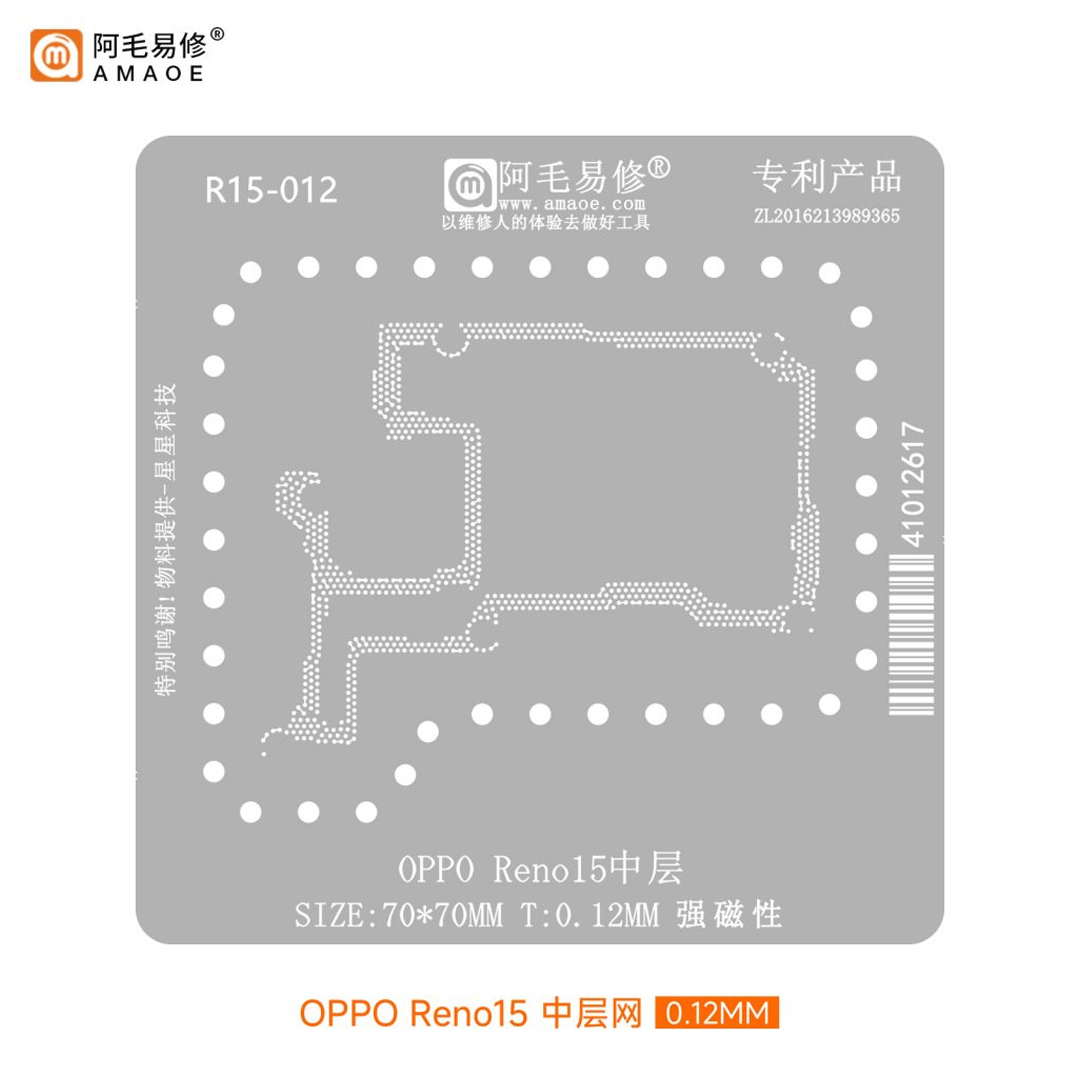
AMAOE R15-012 OPPO RENO15 STENCIL
AMAOE R15-012 (OPPO RENO15) BGA Reballing Stencil
The AMAOE R15-012 (factory designation series OPPO RENO15) is a hardware-specific, high-density BGA reballing stencil engineered for modern, multi-layered smartphone chip architectures. Tailored for repair technicians handling chip-level diagnostics, this tool facilitates seamless reballing of the core application processor, system memory blocks, and specialized peripheral ICs utilized in the Oppo Reno15 series ecosystem.
Crafted using premium, imported Japanese stainless steel and advanced CNC chemical laser micro-machining, it features highly stable thermal properties required to execute complex hardware repairs, including total power recovery, motherboard swaps, and cold-joint restoration.
Product Specifications & Technical Overview
| Attribute | Specification Details |
| Brand | AMAOE (Original Equipment Manufacturer) |
| Model / Part Number | R15-012 / OPPO RENO15 Series Matrix |
| Product Type | Micro-soldering BGA Reballing Stencil Template |
| Material Base | High-tensile, ultra-hard Japanese Stainless Steel (SUS301) |
| Thickness Profile | Exactly 0.12mm (Engineered for optimal micro-BGA pitch clearance) |
| Aperture Engineering | Laser-cut matrix with high-gloss electropolished inner walls |
| Aperture Geometry | Square-centered openings with proprietary micro-rounded corners |
| Structural Features | Integrated anti-bulge heat dissipation slots |
| Max Temperature Tolerance | Safe up to 450°C under localized hot air pressure |
Core Hardware & IC Application Matrix
The layout of the R15-012 consolidates the master computing chipset and secondary critical motherboard drivers onto a single template sheet for optimized workflow efficiency.
| Laser-Etched Module | Associated Chip Function | Diagnostic / Hardware Failure Context | Alignment Difficulty |
| Main SoC Grid | Flagship Application Processor (CPU) | Sudden device death, high-amperage current leakage, drop-induced pad breakage, deep boot loops. | High (Requires microscope inspection) |
| LPDDR5 / 5X Layer | Layered High-Speed RAM Stacking | Storage partition crashes, constant system crashing, failing to boot past the initial logo. | High (Dual-deck interlocking array) |
| UFS Flash Matrix | High-Speed Storage System (NAND) | Operating system read/write errors, storage component firmware bricking. | Medium-High |
| Primary Baseband / RF | Modem Transceiver & Signal Controller | "No Service" status, dropped network bands, unknown IMEI tracking strings. | High (Fine-pitch grid) |
| Master PMIC Array | Central Voltage Power Rail Regulation | Secondary short circuits across motherboard capacitors, dead battery line detection. | Medium |
| Sub-PMIC / Charging IC | Fast-charging Controller & Buck Driver | False charging indications, USB negotiation failure, device unresponsiveness to power inputs. | Medium |
Key Structural Engineering Innovations
1. Premium SUS301 Japanese Steel Composition
The R15-012 stencil leverages specialized Japanese steel alloy with premium shape-memory properties. During demanding reflow tasks, the template absorbs heat and snaps back to its perfectly flat baseline without developing persistent warping or bowing, guaranteeing uniform contact with the PCB pads.
2. Square Openings with Chamfered Corner Radii
Traditional circular stencils trap solder paste inside their apertures due to natural surface tension, resulting in partial sphere formation. AMAOE cuts square apertures modified with rounded internal corner profiles. This reduces surface friction, ensuring complete solder paste release onto the chip pads when lifting the stencil.
3. Exact 0.12mm Height-to-Pitch Calibration
Managing solder thickness is critical on high-density mobile logic boards. The 0.12mm specification yields a uniform deposit that provides structural rigidity and high mechanical resistance against drop impacts, while preventing adjacent solder spheres from expanding laterally and bridging under pressure.
4. Thermal Anti-Bulge Relief Paths
To accommodate localized heat from hot-air station nozzles, the stencil skin includes non-aperture heat dissipation slots adjacent to the densest chip grids. These thermal paths distribute expansion stresses across the sheet, preventing the center of the template from rising or shifting during rework.
| Weight |
0.020 kg |
|---|
Customer Reviews
No Review Found